How to Show Creative Skill Without a Portfolio
Show creative skill without a portfolio using a sample, demonstration or clear account of your contribution, chosen to suit the opportunity and its needs.
The common mistake is to assume a polished portfolio is the only way to show creative skill. That can hide abilities best seen in action: repairing a torn seam, explaining a design choice or adapting a method when materials behave differently. If you need to show creative skill without a portfolio, start with the work itself and choose a form another person can readily inspect.
What can a work sample show?
A sample makes a claim tangible. A tailor might bring a buttonhole, a printer a proof, or a potter a fired tile. Each lets someone inspect decisions and handling that a phrase such as “good with detail” cannot convey on its own.
A sample needs enough context to be understood, but not a long speech. Name the task, the material and any constraint that shaped the result. If the work was collaborative, identify what you did and credit the other contributors.
When is a live demonstration clearer?
Some abilities are difficult to judge from a finished object. A cook’s timing, a musician’s response to a group or a facilitator’s way of inviting quieter voices becomes visible through action. A short demonstration can show the method, the choices behind it and how the person responds to a question.
Say you are learning to mend a torn canvas bag and want to show that you can choose a repair to suit the fabric. You bring the bag, a matching scrap and a sample seam, then explain why you used a patch rather than a simple stitch. The viewer can inspect the finish and ask how you handled the fraying edge; the evidence makes your practical judgement easier to discuss.
How do you choose evidence for an opportunity?
Begin with what the other person needs to assess. A finished illustration can show composition; annotated drafts can reveal editing decisions; a live explanation can show how you teach a technique. Pick the form that makes the relevant ability visible, rather than the form that looks most impressive.
- What can the viewer inspect? If the important feature is visible in the object, bring the object; if not, add a close photograph or diagram.
- Is the task clear? If the purpose is obvious, let the sample speak; if it is not, add a short caption naming the goal.
- Can your contribution be separated? If your role is clear, identify it briefly; if several people shaped the result, state your part and credit theirs.
- Does the skill unfold through action? If the method matters, offer a short demonstration; if it cannot be shown in person, use a recording or annotated sequence.
- Is there a relevant constraint? If a material, audience or deadline shaped your choices, name it; if not, avoid adding context that distracts.
- Could sharing expose private information? If names or personal details appear, remove or cover them; if permission is needed to share someone else’s work, ask first.
How can a small collection make a pattern visible?
A collection need not be a formal portfolio. It might be a folder of sketches, labelled prototypes, annotated recipes or a notebook of short reflections. A few distinct pieces can reveal recurring interests or changing methods without asking a viewer to sift through every attempt.
Think of it as a kitchen drawer of useful utensils, not a display cabinet: each item earns its place by serving a purpose. Keep a finished result, an experiment or a revision only when each adds something different. A dated note or material label can preserve useful context without turning the collection into an essay.
What should you bring when there is no portfolio?
Can an unfinished piece show skill?
Yes, when it helps explain a decision or revision. Pair it with a later version and point to what changed, while making clear which version is complete.
What if the work cannot be brought into the room?
Use a photograph, recording, diagram or written account that preserves the feature being discussed. Say what the chosen format cannot show directly, so the viewer knows where its evidence ends.
How many examples should you show?
Choose enough examples to answer the question, then stop before they blur together. A small set of contrasting pieces with clear context is easier to discuss than a large, unexplained archive.
How can you show your role in shared work?
Name the decisions or tasks that were yours and credit the other contributors. If the division of work is unclear, describe only the parts you can identify honestly.
How can you show creative skill without a portfolio in practice?
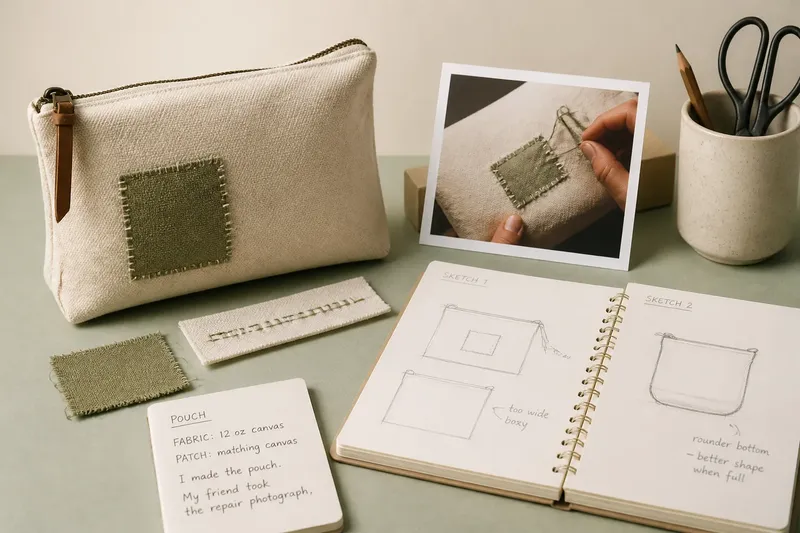
Imagine a learner has a stitched canvas pouch, two paper sketches and a photograph of a repair that is too bulky to carry. The opportunity is a conversation about practical making. They choose the pouch to show a finished object, the sketches to explain how its shape changed, and the photograph to show the repair; they label the pouch’s fabric, mark which sketch came first and state that they made the pouch while a friend took the photograph. The result is a compact set of evidence that shows construction, revision and clear credit, while the photograph remains a record rather than a substitute for inspecting the repair itself.
To show creative skill without a portfolio, match each piece of evidence to the question it can answer. A sample suits close inspection, a demonstration suits a method that unfolds, and a small collection suits a pattern across related work. The most useful final check is simple: can the viewer tell what you did, why it mattered and what the evidence does not claim?