Curiosity Before Commitment: Let a New Interest Stay Small
Curiosity before commitment helps you explore a new interest with a simple, low-pressure activity, notice what holds your attention and choose what to try next.
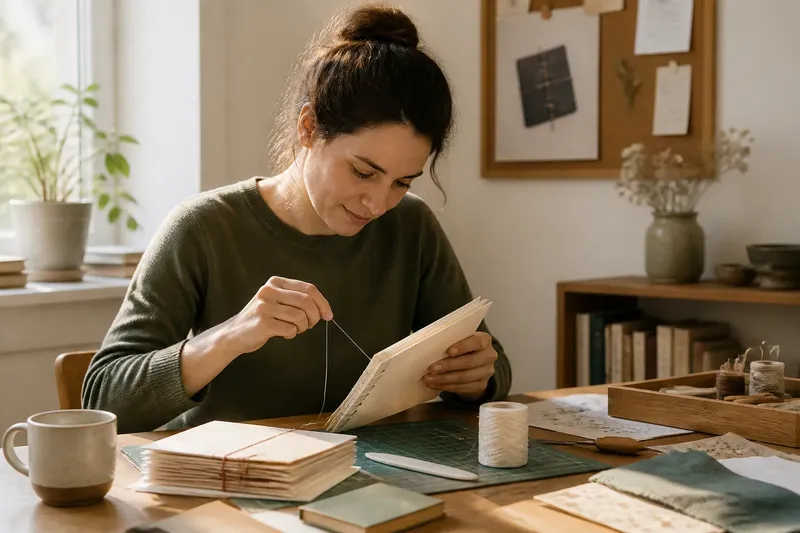
The common mistake with a new interest is turning its first spark into a life decision: buying a full kit, announcing a new direction or asking whether this is finally “your thing”. Curiosity before commitment costs less when it stays small. You can explore an interest, notice what draws you in and change your mind.
Imagine Mara, an invented office administrator, spotting a bookbinding flyer on a community noticeboard. She likes the look of cloth-covered notebooks but has never handled a bone folder or made a stitch. Rather than sign up for a long course, she decides to find out what specifically interests her.
What part of bookbinding catches her attention?
“Bookbinding” is a broad label. It could mean restoring old books, making journals by hand, choosing paper, designing covers or learning how pages hold together. Mara writes down the detail that caught her eye: the visible stitching along a notebook’s spine. Now she has a question to investigate without deciding whether bookbinding belongs in her future.
A general interest can hide several different attractions. Someone curious about gardening might be drawn to starting seeds, arranging a balcony or learning plant names. Someone intrigued by animation might want to sketch movement, tell stories or understand how images are edited. The first task is not to choose a permanent label; it is to make the curiosity specific enough to meet.
Mara also gives herself permission to be a beginner. She need not prove that the interest is serious by collecting supplies or producing something impressive. The point is to notice her response to a small encounter with the subject.
How can she explore bookbinding without a big commitment?
Mara looks for a modest, reversible invitation. The local library has a bookbinding demonstration listed on its events board, and a friend who makes sketchbooks offers to show her a simple pamphlet stitch over tea. She chooses the demonstration first: it fits an ordinary afternoon, requires no special purchase and leaves her free to stop afterwards.
That is different from asking, “Could I become a bookbinder?” The larger question bundles together skill, work, money, time and identity. Mara’s smaller question is easier to answer: “Do I enjoy seeing how a book is put together?” She can learn something useful even if the answer is no.
A small exploration might be a conversation, a public demonstration, a library book, a borrowed tool or a short activity offered by a local group. Choose an invitation that lets you encounter the actual work, not only its polished results. Watching someone fold and stitch paper may reveal more than browsing pictures of finished journals.
At the demonstration, Mara sees folded sheets, thread and a blunt-pointed needle up close. She asks how the pages are held in place and watches the maker work through a sample. It is like opening a drawer to see how its runners move: she is looking at the mechanism, not promising to build furniture.
What can a first encounter tell her?
Mara enjoys the quiet rhythm of folding and aligning pages, but the long explanation of decorative cover materials leaves her attention wandering. Neither response is a verdict on her talent. Together, they show which part of the subject currently holds her interest.
After the demonstration, her friend suggests making one folded-paper booklet with materials already at home. Mara agrees. She takes scrap paper, a ruler, a pencil and thread from her sewing basket, then follows her friend’s instructions for the simple activity. She is learning, not making a display piece.
Say Mara’s first booklet opens unevenly because the folded pages do not line up. She marks where they shift, refolds the paper more carefully and tries once more. The result is a clearer sense of whether she enjoys folding and joining pages; she does not need a perfect notebook or a career plan to learn that.
What should she try next, and what can wait?
After the first excitement softens, Mara asks herself: Which moment held my attention? What felt tedious? Is there a question I genuinely want answered? Would another small encounter be easy to arrange? These prompts are more useful than asking whether she is “good at it” after one brief attempt.
Her answers are mixed but specific: she enjoyed making the folds and wants to understand why different stitch patterns hold pages differently. Choosing cover fabric interested her less. She decides to borrow a library book about simple book structures and make a second small booklet, rather than enrol in a course or buy supplies.
If the next activity feels engaging, Mara can consider a beginner workshop later. If it does not, she can stop without having to explain away a new identity. Either result helps her decide what to do next.
What questions help keep curiosity small?
How long should I explore before deciding?
There is no universal waiting period. Choose an encounter that fits the interest and your available time, then decide whether you want another one; even a brief activity can clarify what you are curious about.
Should I buy equipment before trying the activity?
Not necessarily. Look first for borrowing, demonstrations, library resources or materials already to hand. Buy something only when you know what role it would serve.
What if I lose interest immediately?
Let that be an answer about this encounter, not a judgement about your character. You might have met the wrong part of the subject, or simply discovered that you do not want to pursue it now.
How do I choose a proportionate next step?
Pick an action that follows from a specific question and is easy to pause or leave. For Mara, borrowing a book and making one more booklet answers her question about stitches without committing her to a course.
When does curiosity become a commitment?
For Mara, the turning point is not a dramatic revelation. After the second booklet, she wants to understand how a stitched spine behaves when the pages open. She looks for a local beginner session focused on binding structures and considers whether the time and cost suit her circumstances. Her next decision is still limited: attend one session, not redesign her life.
Curiosity before commitment works best when real, manageable encounters earn more of your attention. Notice which parts hold you, what questions remain and what modest invitation could answer one of them. You can move closer, pause or turn elsewhere; none of those choices makes the first spark a promise.
Mara keeps her first booklet on a shelf, not as proof that she has become a bookbinder, but as a reminder of what she learned to notice. When another interest catches her eye, she can meet it just as lightly: identify its specific appeal, try a small piece of the activity and wait for something concrete before making a larger decision.